New coalitions are often in a rush to get to strategic plans, roadmaps and project plans. The real work of the first three months is learning communications ground rules that are essential to moving through the coalition lifecycle.
Part of Same Table, Different Stories, a series on coalition work and influencing without position authority.
The second meeting in the formation phase of the coalition lifecycle is usually where this starts to surface.
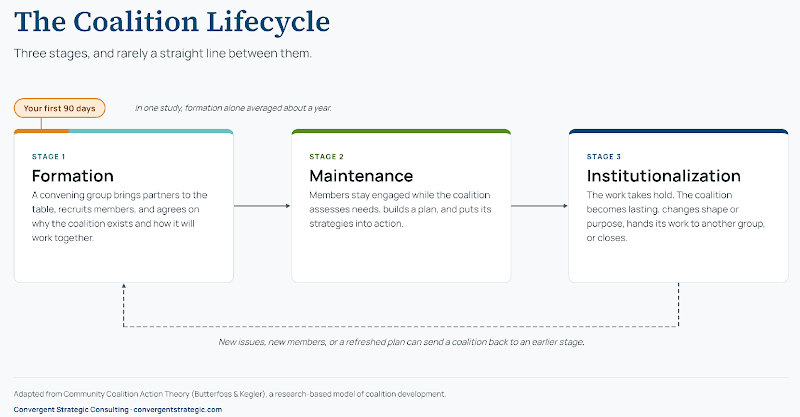
At inception, the convening group brings partners to the table, recruits members with like interests, and starts digging in on why the coalition exists. By the second meeting there is a slide with three strategic priorities, a timeline with quarters on it, and a working group sign-up sheet making its way around the table. People sign up based on their interests.
Across education policy tables, advocacy campaigns, and employer coalitions, this pattern has held steadily enough that it no longer surprises me. The group with a plan by meeting two is very often the group that is quietly stuck by month five. Not because the plan was wrong, moreover it is typically due to a few missed ground rules essential to moving through the coalition lifecycle.
Because nobody in the room had yet learned whether it was safe to really ask what the work is, for whom, what success looks like and how we will measure impact and results.
I now ask the conveners I work with before or during the construction of their first strategic plan and roadmap: when this group has its first real disagreement, where will it be said, and how will it be captured, wrestled with and incorporated into the strategic plan that informs the roadmap?
This is what the first ninety days are for.
Why the goal feels like the work
It makes sense that new coalitions reach for strategy first. The goal is why everyone said yes. Funders want to see momentum, member organizations want something to report back to their boards, and a convener who spends three meetings on anything other than the goal can feel like they are wasting volunteers’ time. A written plan is visible proof that the group is real.
But a coalition’s plan is only as good as the conversation hygiene underneath it, and in the first months those conversations usually haven’t happened yet. Until they’ve seen that, the agreement in the room is provisional: courteous, sincere, and not yet able to hold the weight of progress toward the shared goal.
Agreement reached before trust is borrowed, and fragile. The bill comes due later, and usually at the worst moment: the first public statement, the first budget ask, the first time the policy environment shifts and staying at the table starts to cost something.
What the first ninety days are for
There is a moment in Tolkien’s The Fellowship of the Ring that I return to whenever I think about how coalitions begin. A council gathers peoples with long histories of distrust and very different stakes in the outcome and sends a small company out together. The host who sends them deliberately lays no oath on them. Each may go only as far as they choose. It is often read as a kindness. I read it as an accurate description of what a voluntary group is: people who renew their commitment, or don’t, every single day.
A coalition effort is in a similar condition. Nobody is bound. Which means the first job is not to agree on the route. It is to learn enough about each other that you will keep on the journey together even when the route turns out to be harder than the map or the original vision suggested.
In practice, I think of the first ninety days as having three tasks. None of them is the goal, but prepares you for each phase of the journey.
Learn why each person came. Not their organization’s reason. Theirs. The program director whose board asked her to be here has a different relationship to this work than the executive who has been carrying it alone for a decade, and both differ from the newcomer sent because his boss couldn’t make it. The founding purpose statement covers all of them in fair weather. The individual reasons tell you who stays when the weather changes.
Decide how disagreement gets raised and dealt with here. Most groups have rules about attendance and voting. Very few have an agreement about dissent: whether it is expected in the room, how it gets raised, and what the convener will do with it. Without one, disagreement still happens. It just happens somewhere else, and the convener hears about it last.
Watch what happens to the first person who takes a risk. Sometime in the first ninety days, someone will say something that makes others uncomfortable. They may question the premise, name a past failure, or admit their organization can’t deliver what it signed up for. How the room responds and treats this early risk teaches everyone else whether candor here is rewarded, punished or ignored.
What it looks like when a group gets this step right
One new table I worked with (the details here are blended from more than one, as they always are in this series) afforded the opportunity to create norms for critical conversations, a process for handling them, and a path to iterate on new realizations and insights in alignment with the coalition goal on a regular basis. It was as simple as asking a kick starter question at the start of each meeting like, what does your organization need from this coalition that it can’t say on the record? Or what did the last coalition you joined get wrong? Or what would make you quietly stop showing up?
The answers will be uncomfortable. Two members discovered they were pursuing the same funding. One admitted her leadership was skeptical of the whole effort and had sent her mostly to keep an eye on things. A member from a smaller organization said, carefully, that she had stopped speaking up in an earlier coalition because the large organizations always seemed to have decided before the meeting started.
By month three, the strategic plan document that took shape looked a great deal like something that reflected what the coalition’s collective capacity really represented that they had the ability to do.
Something to try before your next meeting
If you are convening a group that is still new, take one strategy item off your next agenda and put a single question in its place. Ask it of every person at the table, and answer it yourself first:
What would you need to be able to say in this room that you can’t say yet?
Then pay attention to two things: who answers honestly, and what you do with what they tell you. The first shows you where your group’s trust stands today. The second is how you start building more of it.
If your coalition is already past ninety days, the question still works because your strategic plan is a living document.
The strategic plan can be a living document
Every coalition eventually gets the plan it is capable of carrying out with the right communication foundation, trust, honesty, and a good process for feeding a living strategic plan document.
Sources
- Butterfoss, F. D., & Kegler, M. C. (2002). Toward a comprehensive understanding of community coalitions: Moving from practice to theory. In R. J. DiClemente, R. A. Crosby, & M. C. Kegler (Eds.), Emerging theories in health promotion practice and research. Jossey-Bass.
- Kegler, M. C., Rigler, J., & Honeycutt, S. (2010). How does community context influence coalitions in the formation stage? A multiple case study based on the Community Coalition Action Theory. BMC Public Health, 10, 90. https://doi.org/10.1186/1471-2458-10-90
Next in this series: The Thing Nobody Will Say in Front of a Competitor, on building candor between organizations whose members have real reasons to be guarded.
Convergent Strategic Consulting works with coalitions, partnerships, and leadership teams from their first meeting forward. If you are convening a group that is still finding its footing, let’s talk →